I took a trip to the Forest of Dean yesterday. I didn't do any research on where would be best but simply used my own judgement from the map.
Within 15 minutes of home I had my first interesting sighting when a hare ran out into the road. She had clearly been to the pheasant school of road safety as she stopped and then turned round and went back the way that she had come. It was my first hare for quite a few years and the first in Bucks.
I parked at Cannop Ponds, at first it just looked like the typical collection of mallard, tufty and coot but then I spotted some mandarin ducks. I hadn't been aware of the colony in the area until looking it up afterwards. As well as on the lake I explored the marshy ground below the dam and spotted another pair.
Walking south along the old railway it did rather feel as if I had wandered into Center Parcs as it all seemed so manacured. I only had a couple of hints that I was on a railway track at all.


 I might have planned a different walk if I had researched this but I had to return to the car which wasn't consistent with climbing for a mile or more up a steep, dead end, valley so I took a forestry road that would take me back in a loop. That was the plan anyway, I hadn't walked far when I saw something large and black in the long grass ahead. It didn't take long to realise that it was a wild boar. With no signal for my phone and nobody else around now that I was out of the tourist area I decided that it would be prudent to follow the Forestry Commission advice on boar encounters and to turn round and go back the way I came.
Back at the upper pond I added a dabchick to the list before driving to Parkend for a much needed cup of tea. The second walk was from New Fancy Colliery to Parkend and back. The stream running between the two is very marshy in places and I saw several more mandarin duck although nothing else of birding interest.
Within 15 minutes of home I had my first interesting sighting when a hare ran out into the road. She had clearly been to the pheasant school of road safety as she stopped and then turned round and went back the way that she had come. It was my first hare for quite a few years and the first in Bucks.
I parked at Cannop Ponds, at first it just looked like the typical collection of mallard, tufty and coot but then I spotted some mandarin ducks. I hadn't been aware of the colony in the area until looking it up afterwards. As well as on the lake I explored the marshy ground below the dam and spotted another pair.
Walking south along the old railway it did rather feel as if I had wandered into Center Parcs as it all seemed so manacured. I only had a couple of hints that I was on a railway track at all.
This solitary fencepost hinted at something rather more industrial than the usual forest fencing while when I reached the dam at the bottom of the lower lake I came across a loading dock.
A sign named this as Cannop Wharf and I discovered afterwards that it was used unitl the end of WW2 for transferring coal from the Bicslade Tramroad to railway wagons. Walking across the dam, following as I later discovered, the course of the tramroad I was lucky to see both grey and pied wagtails as well as a cormorant and greylag geese on the lake.
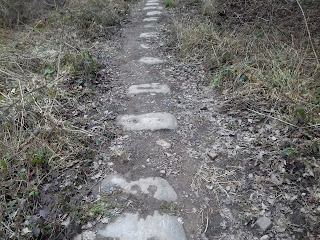
Climbing up a steep side valley (Bixslade) I discovered the first solid evidence of the tramroad.

Back at the upper pond I added a dabchick to the list before driving to Parkend for a much needed cup of tea. The second walk was from New Fancy Colliery to Parkend and back. The stream running between the two is very marshy in places and I saw several more mandarin duck although nothing else of birding interest.
Comments